
From Domain Design to REST API: Building FastURL with FastAPI
Posted on 20 Sep 2026
Introduction
In the previous article we established the theory: requirements produce domain entities, domain entities become REST resources, and HTTP methods map to the lifecycle operations of those resources. Kubernetes was the illustration — large enough to make the pattern clear, but too complex to implement in a blog post.
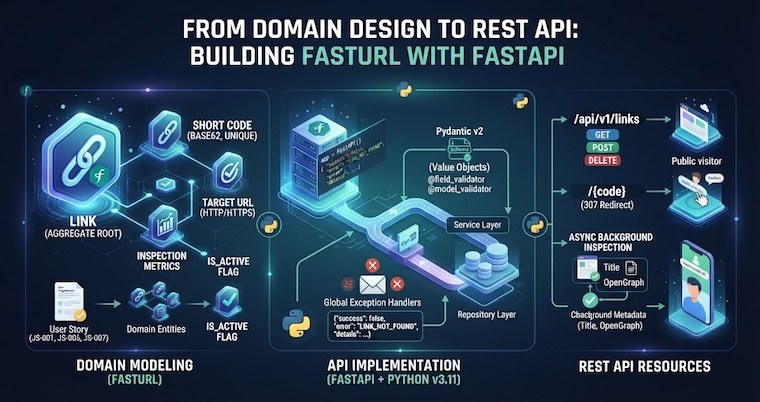
This article moves from theory to practice. The project is FastURL, a URL shortener and link inspector built with FastAPI. It is small enough to fit comfortably in a few articles, but real enough to demonstrate every concept that matters: domain modeling, Pydantic validation as a form of type-safe Value Objects, a standardized error envelope, and a resource hierarchy derived directly from the domain.
You should read this article if:
- You have read the previous article and want to see the methodology applied to real code.
- You want to understand how Pydantic v2 validators enforce domain rules at the HTTP boundary.
- You want to see how a consistent error contract is designed and implemented from scratch.
What FastURL Does
FastURL is a REST API that shortens long URLs into compact 7-character codes and resolves them back via HTTP redirects. Beyond basic shortening, it runs an asynchronous background inspection on every newly created link: it fetches the target page, records the HTTP status code and latency, and extracts the HTML title and OpenGraph metadata.
Three actors interact with the system:
| Actor | Description |
|---|---|
| API Client | Creates, lists, retrieves, and deletes shortened links |
| Public Visitor | Navigates to a short URL and gets redirected to the target |
| Background Inspector | Asynchronously checks target URL health after creation |
This actor breakdown comes directly from the requirements document — before any code was written. The nouns in the job stories (Link, ShortCode, TargetUrl, Inspection, Metrics) became the domain entities. The verbs (shorten, resolve, inspect, delete) became the operations.
From Requirements to Domain Entities
Every requirement in FastURL can be traced to one of eight job stories documented in the requirements document. Three of them are worth looking at closely because they drive the entire domain design.
JS-001 — When I provide a valid target URL, I want a unique shortened URL with a random alphanumeric code. This story introduces two domain concepts: a Link (the association between a short code and a target URL) and a ShortCode (a validated 7-character Base62 string). The story also establishes a business rule: the code must be unique and collision-resistant.
JS-006 — When I navigate to a short URL, I want to be redirected immediately. This story adds two more rules: the link must be active (is_active = true) and must not have passed its expiration date (expires_at). If either condition fails, the redirect must not happen.
JS-007 — When a new link is registered, I want a non-blocking background check on the target URL. This story introduces the LinkInspection concept: a snapshot of target URL health, latency, and page metadata. Crucially, it must not block the creation response — the system acknowledges the creation immediately and inspects asynchronously. This is the async I/O pattern we covered earlier in the series.
These three stories alone define the core of the domain model.
The Domain Model
FastURL has a single Aggregate Root: Link. It owns all the data and enforces all invariants. The Value Objects — ShortCode, TargetUrl, LinkMetrics, and LinkInspection — are part of the Link aggregate, not separate entities with their own identity.
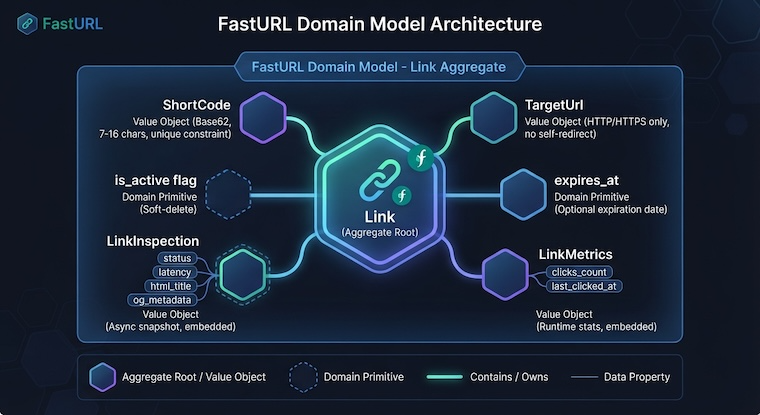
Link (Aggregate Root)
├── code          ← ShortCode (Base62, 7–16 chars, unique)
├── target_url    ← TargetUrl (HTTP/HTTPS only, no self-redirect)
├── is_active     ← soft-delete flag
├── expires_at    ← optional expiry
├── inspection    ← LinkInspection (status, latency, title, og:*)
└── metrics       ← LinkMetrics (clicks_count, last_clicked_at)
There are two bounded contexts: LinkManagement (CRUD and redirect resolution) and LinkInspection (async health check and metadata extraction). They communicate via a LinkCreated event that triggers the background task.
A single aggregate with Value Objects as members keeps the domain model flat and readable.
LinkInspectionandLinkMetricshave no identity of their own — they only make sense as part of aLink.
Mapping Entities to Resources
The mapping from domain to REST is direct:
| Domain Entity | REST Resource | Methods |
|---|---|---|
Link collection |
/api/v1/links |
GET, POST |
Link instance |
/api/v1/links/{code} |
GET, DELETE |
LinkInspection action |
/api/v1/links/{code}/inspect |
POST |
| (public redirect) | /{code} |
GET |
Notice that /{code} carries no /api/v1/ prefix. This is intentional: it is a consumer-facing URL that must be short and stable, not a versioned management endpoint.
The POST /api/v1/links/{code}/inspect endpoint does not map to a CRUD operation — it triggers an action. As discussed in the previous article, POST is the correct method for non-CRUD actions on a resource.
Pydantic as Value Object Implementation
In Domain-Driven Design, a Value Object encapsulates validation rules and equality semantics. In FastAPI, Pydantic models serve exactly this role at the HTTP boundary. The LinkCreateRequest schema enforces every business rule on inbound data before the service layer is ever called.
class LinkCreateRequest(BaseModel):
    target_url: HttpUrl = Field(
        description="Destination URL to shorten. Must be HTTP or HTTPS.",
    )
    custom_code: str | None = Field(
        default=None,
        min_length=7,
        max_length=16,
    )
    expires_at: datetime | None = Field(default=None)

    @field_validator("custom_code")
    @classmethod
    def validate_custom_code(cls, v: str | None) -> str | None:
        if v is not None and not _BASE62_PATTERN.match(v):
            raise ValueError("custom_code must contain only alphanumeric characters [a-zA-Z0-9]")
        return v

    @model_validator(mode="after")
    def validate_expires_at_future(self) -> LinkCreateRequest:
        if self.expires_at is not None:
            now = datetime.now(UTC).replace(tzinfo=None)
            expires = self.expires_at.replace(tzinfo=None)
            if expires <= now:
                raise ValueError("expires_at -> Expiration date must be in the future")
        return self
Breaking down what each element enforces:
HttpUrl— Pydantic’s built-in type rejects any URL that is not HTTP or HTTPS. No custom validator needed for the scheme.@field_validator— Enforces the Base62 alphabet rule: only[a-zA-Z0-9]. This is theShortCodeValue Object’s constraint, expressed as a Pydantic field-level validator.@model_validator(mode="after")— Runs after all fields are validated, so it can accessself.expires_at. It rejects expiration dates in the past. This is a cross-field invariant that requires the full model context.
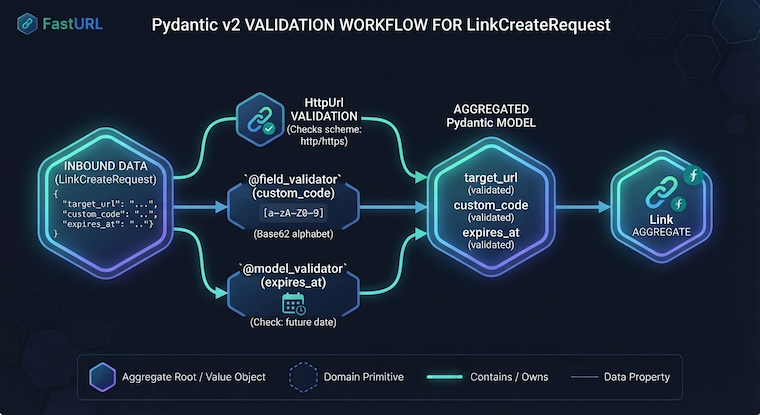
The response schema mirrors the domain structure: LinkResponse embeds InspectionResponse and MetricsResponse, reflecting the LinkInspection and LinkMetrics Value Objects in the aggregate.
class LinkResponse(BaseModel):
    code: str
    short_url: str
    target_url: str
    is_active: bool
    expires_at: datetime | None = None
    inspection: InspectionResponse
    metrics: MetricsResponse
    created_at: datetime
    updated_at: datetime
Note that id — the internal surrogate key — is absent from the response. The code is the sole public identifier. This is a deliberate design choice: a sequential integer PK is enumerable and guessable; a Base62 7-character code is not.
The Error Envelope
One of the most important consistency decisions in any API is the error contract. FastURL uses a single envelope for every error response:
{
  "success": false,
  "error": "LINK_NOT_FOUND",
  "details": [
    "code -> No link found with code 'aB3x9zK'"
  ]
}
The error field is a machine-readable short code. The details list contains human-readable, field-level explanations. This structure lets clients branch on error programmatically and display details to a developer or end user.
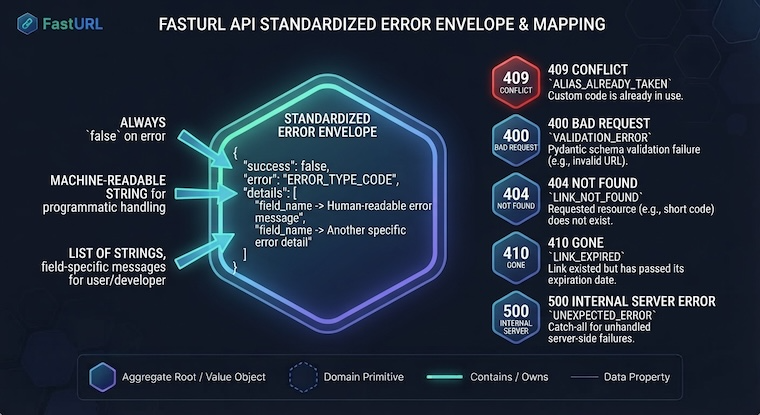
Domain Exceptions
Domain exceptions are pure Python classes — no FastAPI imports, no HTTP knowledge. They carry only the data needed to build the error response.
class LinkNotFoundError(AppError):
    def __init__(self, code: str) -> None:
        super().__init__(
            message="LINK_NOT_FOUND",
            status_code=404,
            details=[f"code -> No link found with code '{code}'"],
        )

class AliasAlreadyTakenError(AppError):
    def __init__(self, alias: str) -> None:
        super().__init__(
            message="ALIAS_ALREADY_TAKEN",
            status_code=409,
            details=[f"custom_code -> The alias '{alias}' is already in use"],
        )

class LinkExpiredError(AppError):
    def __init__(self, code: str, expired_at: str) -> None:
        super().__init__(
            message="LINK_EXPIRED",
            status_code=410,
            details=[f"code -> Link '{code}' expired on {expired_at}"],
        )
The AppError base class holds the message, status_code, and details. Subclasses just set the right values in __init__. The service layer raises these exceptions; the HTTP layer never needs to know how they are structured.
Global Exception Handlers
Three handlers registered in main.py cover every failure path:
def register_exception_handlers(app: FastAPI) -> None:

    @app.exception_handler(RequestValidationError)
    async def validation_exception_handler(request, exc) -> JSONResponse:
        error_details = []
        for e in exc.errors():
            loc = " -> ".join(str(x) for x in e["loc"])
            msg = e["msg"]
            error_details.append(f"{loc}: {msg}")
        return JSONResponse(
            status_code=400,
            content={"success": False, "error": "VALIDATION_ERROR", "details": error_details},
        )

    @app.exception_handler(AppError)
    async def app_error_handler(request, exc) -> JSONResponse:
        return JSONResponse(
            status_code=exc.status_code,
            content={"success": False, "error": exc.message, "details": exc.details},
        )

    @app.exception_handler(Exception)
    async def global_exception_handler(request, exc) -> JSONResponse:
        # Full traceback logged server-side; generic message returned to client
        return JSONResponse(
            status_code=500,
            content={"success": False, "error": "INTERNAL_SERVER_ERROR",
                     "details": ["An unexpected error occurred. Please contact support."]},
        )
The three handlers map precisely to the three failure categories:
| Handler | Triggered by | HTTP status |
|---|---|---|
RequestValidationError |
Pydantic schema validation failure | 400 |
AppError |
Domain rule violation (not found, conflict, expired) | 404 / 409 / 410 |
Exception |
Any unhandled error | 500 |
The third handler is the safety net. It logs the full traceback server-side but returns only a generic message to the client — no stack traces, no internal details, no information disclosure.
The Full Endpoint Table
Bringing everything together, here is the complete API surface of FastURL:
| Endpoint | Method | Status codes | Description |
|---|---|---|---|
/api/v1/links |
POST |
201, 400, 409 | Create a shortened link |
/api/v1/links |
GET |
200, 400 | List links with optional filters |
/api/v1/links/{code} |
GET |
200, 404 | Retrieve a single link |
/api/v1/links/{code} |
DELETE |
204, 404 | Soft-delete a link |
/api/v1/links/{code}/inspect |
POST |
202, 404 | Trigger background re-inspection |
/{code} |
GET |
307, 404, 410 | Redirect to target URL |
A few design decisions worth noting:
DELETEreturns204 No Content— no body, because there is nothing meaningful to return after a deletion.POST /api/v1/links/{code}/inspectreturns202 Accepted— not200 OK. The inspection runs asynchronously; the client receives the current snapshot immediately and pollsGET /api/v1/links/{code}for the result.GET /{code}can return410 Gonefor expired links.410is semantically different from404: it signals that the resource existed but is permanently unavailable, not that it was never found.
Conclusion
In this article we covered:
- From job stories to domain entities: how the nouns and verbs in requirements directly produce the
Linkaggregate, theShortCodeandTargetUrlValue Objects, and theLinkInspectionandLinkMetricsembedded snapshots. - Pydantic as Value Object implementation: using
HttpUrl,@field_validator, and@model_validatorto enforce domain invariants at the HTTP boundary — before the service layer is called. - A consistent error envelope: a single
{success, error, details}structure for every failure, backed by domain exceptions that carry no HTTP knowledge and three global handlers that translate them. - Resource hierarchy derived from the domain: five management endpoints plus a public redirect endpoint, each with a clear ownership and a precise set of status codes.
The next article walks through the layered code structure that makes all of this work: how routers, services, repositories, and the dependency injection system are organized to keep each concern in its own place.
If you enjoyed this article, don’t forget to give it a clap 👏, share it with your friends 🔗, and follow me for more tips and tutorials on software development 📘. Your support helps me create more content like this — thank you! 🙌

